
Bizarre. I got a message on LinkedIn from an employee at Viotel Ltd who requested my marketing assistance on a project. I will repost the message here simply because, as dramatic as my writing may be, it does not equal the level of drama proposed in this endeavor (emphases all mine).
"...As part of our social community development and responsibility we are doing a reality show entitled: 'Royalty Africa Culture Quest'. The show would feature 20-30 african males and females from all over the world who would be camped in the RoyaltyAfrica village of beautiful mud houses and thatched roofs (the typical african environment way back).
The contestants/housemates would engage in different tasks including cultural dances of the various african kingdoms, stage drama, african stories, african poetry and other mental tasks to test their personality and leadership qualities.
At the end of eight (8) weeks the male and female winners will be crowned Royalty African King and Queen and they will walk away with some cash prizes and become Royalty Africa Ambassadors. They will be chosen by a council of village elders and by TV viewer votes. We are seeking sponsors and partnerships worldwide so that this program will air in the Americas, Asia and Europe."
Will we see the sunset over palm trees? Baby goats roaming the village? As much as I often think that Hollywood/Western audiences/media entities promote misconceptions about Africa and Africans, I think that some Africans are working twice as hard. As far as reality shows go, I don't think I've ever heard of a bigger train wreck.
I'd rather watch Eddie Murphy, in Coming to America, pat his pet elephant Babar in a fake jungle than this African "cultural" fete. I'd rather watch a blackened Kerry Washington fake a South African accent while cheating on Idi Amin (Forest Whitaker) with his physician lackey.
I could go on. Point is, all of these things are far less offensive than watching a group of cosmopolitan Africans "pretend" to live in the bush on television for a global audience. My issue is not so much with the would-be contestants as the African producers who conceived of it.
"...As part of our social community development and responsibility we are doing a reality show entitled: 'Royalty Africa Culture Quest'. The show would feature 20-30 african males and females from all over the world who would be camped in the RoyaltyAfrica village of beautiful mud houses and thatched roofs (the typical african environment way back).
The contestants/housemates would engage in different tasks including cultural dances of the various african kingdoms, stage drama, african stories, african poetry and other mental tasks to test their personality and leadership qualities.
At the end of eight (8) weeks the male and female winners will be crowned Royalty African King and Queen and they will walk away with some cash prizes and become Royalty Africa Ambassadors. They will be chosen by a council of village elders and by TV viewer votes. We are seeking sponsors and partnerships worldwide so that this program will air in the Americas, Asia and Europe."
Will we see the sunset over palm trees? Baby goats roaming the village? As much as I often think that Hollywood/Western audiences/media entities promote misconceptions about Africa and Africans, I think that some Africans are working twice as hard. As far as reality shows go, I don't think I've ever heard of a bigger train wreck.
I'd rather watch Eddie Murphy, in Coming to America, pat his pet elephant Babar in a fake jungle than this African "cultural" fete. I'd rather watch a blackened Kerry Washington fake a South African accent while cheating on Idi Amin (Forest Whitaker) with his physician lackey.
I could go on. Point is, all of these things are far less offensive than watching a group of cosmopolitan Africans "pretend" to live in the bush on television for a global audience. My issue is not so much with the would-be contestants as the African producers who conceived of it.
 Interaction! Yes.
 One of my college mates, Whoopi, is investigating the representation of Africa in global media, specifically Hollywood films. She has an online survey that you can take if:
you are aged between 18-35,
AND
have at least one tertiary (university) degree,
AND
fulfill at least one of the following criteria:
1. Have studied abroad from your country of origin for at least 6 months,
2. Have traveled extensively outside your country of origin during your lifetime,
3. Grew up in a multicultural, ethnic, and/or racial household,
4. Are a first generation immigrant (i.e. grew up in the Western world born of non-Western parents), or
5. Have dual/multiple citizenship including a passport from an African country.
Contact her for more info/questions at chungu@usc.edu.
Went to a panel discussion at NYU Wagner School of Public Service tonight, with participation of FilmAid, Communication for Change, and Barefoot Workshops (skypeing in from South Africa) -- all organizations that teach video workshops in refugee camps, NGOs, and educational settings in Africa. I showed up a little prickly after a long day at work, expecting the same-old panel talk with a few US-based organizations peddling brochures covered in dusty brown children.
And I did largely encounter what I expected, with the exception of Barefoot, that also invited a budding Nigerian filmmaker, in Capetown for a video workshop, to participate in the discussion. The filmmaker, Jonah, had lost both of his parents to HIV/AIDS and wanted to shoot a documentary to educate Nigerians about the disease. Education is largely the goal of these trainings, offering refugees and other at-risk populations a media-driven tool for battling gender-based violence, disease, and even female circumcision.
I suppose in a way, I did not know what was meant by "participatory filmmaking." I thought that these folks maybe collaborated with Africans to make feature films that were competitive on a global scale. Pardon my ignorance. Most of the films were in the style of PSAs, or stories that appealed to a local audience, and the quality was kind of hit or miss.
I understand that the local communities are the target audiences, and mainstream audiences are not a main target (as far as I could tell no distribution networks even exist to this end), but I think that high-level filmmaking should still be a goal.
I suppose I would have liked to have seen the act of filmmaking itself used as a vehicle for radical autonomy, ie, equipping the refugees with the tools and vocabulary to make films on par with those readily consumed in the West. I had a great conversation with MTV Africa head Alex Okosi about this a couple years ago, and he said that a rising number of Africans are fairly sophisticated movie viewers.
I think these video workshop participants should be grappling with the same creative dilemmas as independent filmmakers. All it would have taken to do this was a bit of diffusion here, some tighter sound editing there, a little bit more attention paid to the picture itself and I would not have felt like these organizations were doling out a remedial film education.
I have seen the curriculum for some of the inner-city video programs happening in New York and they are teaching youth at a more sophisticated level. Although, disclaimer, I have not seen these organizations' curricula, and I must also admit that funding may play a significant role, since FilmAid was so much better than the other two.
I do not believe that, even in the remotest villages with no access to television, that a person cannot enter into the pantheon of acclaimed filmmakers if given the same tools and vocabulary. My ten cents.
And I did largely encounter what I expected, with the exception of Barefoot, that also invited a budding Nigerian filmmaker, in Capetown for a video workshop, to participate in the discussion. The filmmaker, Jonah, had lost both of his parents to HIV/AIDS and wanted to shoot a documentary to educate Nigerians about the disease. Education is largely the goal of these trainings, offering refugees and other at-risk populations a media-driven tool for battling gender-based violence, disease, and even female circumcision.
I suppose in a way, I did not know what was meant by "participatory filmmaking." I thought that these folks maybe collaborated with Africans to make feature films that were competitive on a global scale. Pardon my ignorance. Most of the films were in the style of PSAs, or stories that appealed to a local audience, and the quality was kind of hit or miss.
I understand that the local communities are the target audiences, and mainstream audiences are not a main target (as far as I could tell no distribution networks even exist to this end), but I think that high-level filmmaking should still be a goal.
I suppose I would have liked to have seen the act of filmmaking itself used as a vehicle for radical autonomy, ie, equipping the refugees with the tools and vocabulary to make films on par with those readily consumed in the West. I had a great conversation with MTV Africa head Alex Okosi about this a couple years ago, and he said that a rising number of Africans are fairly sophisticated movie viewers.
I think these video workshop participants should be grappling with the same creative dilemmas as independent filmmakers. All it would have taken to do this was a bit of diffusion here, some tighter sound editing there, a little bit more attention paid to the picture itself and I would not have felt like these organizations were doling out a remedial film education.
I have seen the curriculum for some of the inner-city video programs happening in New York and they are teaching youth at a more sophisticated level. Although, disclaimer, I have not seen these organizations' curricula, and I must also admit that funding may play a significant role, since FilmAid was so much better than the other two.
I do not believe that, even in the remotest villages with no access to television, that a person cannot enter into the pantheon of acclaimed filmmakers if given the same tools and vocabulary. My ten cents.
This might be the lamest thing I've ever seen. Not the text, by the brilliant Binyavanga Wainaina, but rather the video.
Is it that they stuck Djimon Hounsou, a two-time Oscar-nominated actor, in a 10x12 bedroom with a little girl surrounded by photographs and taxidermied animals...or the cliche music...or the montage of starving children at the end that only reinforces stereotypes of Africa, turning the entire piece on its head...or the tagline/plug, "Great Music Saves Lives"? Maybe a combination of all of them.
This is exactly my problem with Bono's whole RED campaign. If making change really were as easy as buying a T-shirt, then we wouldn't need more activists, we'd need more hawkers. And I really don't think rock stars should liken themselves to politicians, but I guess I'm no expert.

Last night Imagenation premiered “The Jackson 5 in Africa,” directed by the late Mamadou Johnny Sekka, a never-before-seen documentary chronicling the J-5’s concert tour to Senegal in 1974. It was the single most fascinating thing I’ve seen in the last ten years -- equal parts propaganda film, time capsule, and jam session – featuring the entire Jackson clan and the “spiritual…spirited…and rhythmic” people of Senegal. If you didn't see it, the film's West Coast premiere is at the Los Angeles Downtown Film Festival in August.
Imagenation Founder Moikgantsi Kgama got her hands on the film from an African-American investor who, in the 1980s, acquired a 16mm print of the original in exchange for a rough cut diamond. The film was funded by a group of African investors looking to bridge the gap between Africans and African-Americans, using the J-5 as the catalyst. They eventually ran out of funds and never finished the movie; the picture and, occasionally, sound fall out at points and the whole thing ends abruptly at 50 minutes.
But there was such a strong vibe in the audience last night—you might call it love—that I’m certain we would’ve continued staring at that white screen and singing along to J-5 jams as long as the soundtrack kept running.
Just seconds off the plane, the Jacksons are surrounded by sabar dancers in regal attire, Randy joining in as the narrator cites his ability to pick up the rhythm as “something basic” in the African personality. It continues on in that peculiar mysticism as the family tours the National Palace, a primary school, and the Medina, where candle lights in tin-roofed huts are likened to "twinkling stars" in the night sky.
The boys were captured at a rare point in their lives—not yet jaded by fame, still young enough to be awestruck by skyscrapers in the capital and slave dungeons on Gorée Island. Decked in royal beads, they move with a grace and carriage typically reserved for older men. Michael, barely taller than the podium, honoring President Leopold Senghor with their latest gold record. Joe Jackson receives the Medal of the Lion for his contributions to culture, only the second African-American after Duke Ellington to receive the honor.
What was evident from their first sold out performance at Demba Diop stadium, was not only how wide the J-5's international appeal was, but also how plugged in to contemporary African-American culture the 1970's Senegalese—and indeed all Africans—were. From their clothes to their style, hair, and swagger, the Africans could have been jamming in a stadium in Detroit.
For all the love in the room last night, the message was clear: Africa is in need of her displaced persons if she is to regain her status in the world.
May 26, 2009
 After Katiti King's jazz class @ DNA on Saturday, I went to the DanceAfrica Festival @ Brooklyn Academy of Music. I got to dance in the street and see some folks I haven't laid eyes on since moving to the Bronx. Ronald K. Brown/Evidence performed this year (pictured above).
I've been a festival regular since before I moved to NYC, taking a bus in just to spend the day bargaining with street vendors. Six years later it can feel a bit like same shit different day, although my girl Lady Black's sister, a painter, had this amazing portable art -- suitcases and briefcases that she covered in images of Africa and afro-ed sistas. I really should have copped one, definitely something I'd never seen before. I came correct, though -- bought some raw shea butter, a leopard-print clutch, agate ring, and green-and-white-striped bangle. Now accessorized, I am so ready for the IAFF.
Spent Memorial Day at home writing. Bliss. :)
After Katiti King's jazz class @ DNA on Saturday, I went to the DanceAfrica Festival @ Brooklyn Academy of Music. I got to dance in the street and see some folks I haven't laid eyes on since moving to the Bronx. Ronald K. Brown/Evidence performed this year (pictured above).I've been a festival regular since before I moved to NYC, taking a bus in just to spend the day bargaining with street vendors. Six years later it can feel a bit like same shit different day, although my girl Lady Black's sister, a painter, had this amazing portable art -- suitcases and briefcases that she covered in images of Africa and afro-ed sistas. I really should have copped one, definitely something I'd never seen before. I came correct, though -- bought some raw shea butter, a leopard-print clutch, agate ring, and green-and-white-striped bangle. Now accessorized, I am so ready for the IAFF.
Spent Memorial Day at home writing. Bliss. :)
 That's me at about ten-years-old drinking coconut water on my uncle's lawn in Uyo, Nigeria. Those were my favorite pair of glasses, blue and pink plastic hexagons, that I picked every two years, religiously, when my mom took me to the eye doctor.
There are far stranger stories from my childhood, all of which led me to start penning a memoir, Alligator Legs. It's a nickname my big sisters gave me as a kid when I scratched my legs so much that they grew bumpy from childhood eczema. I was sickly, in and out of the hospital with asthma attacks, and generally uncomfortable in my own skin.
Today, I am a Stanford University biology graduate completing MFA studies at NYU graduate film. I am a professional writer and editor, most recently awarded a 2009 Hedgebrook Writers Residency.
First conceived in 2003, Alligator Legs is a novel based upon my experiences growing up the youngest of four daughters of Nigerian immigrants living in that difficult space between Africa and America.
The protagonist of Alligator Legs is a little girl from a working class immigrant family trying to fit in somewhere that will never be home -- negotiating what it means to be a girl or boy, pretty or ugly, rich or poor, in often hostile territory.
I plan to finish a draft of Alligator Legs by May 2009 and begin working on a screenplay adaptation of the novel. This blog is a place to share my thoughts and explore ideas emerging from my writing and filmmaking. I also hope to gain insight from other writer/filmmakers engaged in similar endeavors.
Drop me a line and say hello or post a comment. I love hearing from my blog readers especially while killing time at work. ;)
Today is opening night for the 15th Annual African Diaspora Film Festival in NYC. Take a look at Dollars and Dreams: West Africans in New York, co-produced by Abdel Kader Ouedraogo, owner of The Shrine nightclub up in Harlem.
Africans are doing some great work out there -- so give support!
Peace,
Iquo.
______OPENING NIGHT FILM: A WINTER TALE (US PREMIERE)
Canada, 2007, 100mins, drama, English, Frances-Anne Solomon, dir.

Shots ring out one winter night and a bullet meant for a local street dealer kills a ten-year-old boy. In the downtown Toronto community of Parkdale, grief and suspicion hang heavily in the air, while the nightly patrons at Miss G's Caribbean TakeAway resume their ritual of beer and banter. But one of them, Gene Wright, cannot go on. He begs his friends for help. In a most unusual development, six Black men make a pact to form a support group in hopes of salvaging their broken spirits and redeeming their besieged community. A Winter Tale is set against the backdrop of a multicultural community's unrealized hopes and dreams. Bitter and tragic, funny and hopeful, the film not only tells a uniquely Canadian story that features Toronto as a central character, it also tells the universal story of Black men looking to assert their humanity in this world. Fri. Nov. 23 @ 7:45pm Opening Night at Anthology Film Archives. Q&A after the screening followed by a catered Opening Night Party at Bonafide's Restaurant; Sun, Nov. 25 @ 6:00pm at Thalia Theatre - Q&A after the screening; Sat. Dec. 1 @ 3:30pm at Anthology Film Archives.
______DOLLARS AND DREAMS, US PREMIERE
US, 2007, 65mins, doc, English, Jeremy Rocklin, dir.
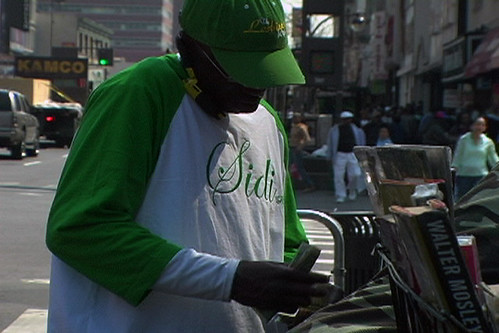
Dollars and Dreams is a documentary film focused on the pursuits and challenges of numerous West African immigrants as they confront the idea of the American Dream and the reality of the New York experience. Including additional perspective from scholars, authors, and community leaders, the film creates a vibrant portrait of African achievement throughout the city, while exploring the complicated issues African immigrants face as they balance their deep connections to Africa and their enthusiastic commitments to America. Sat. Nov. 24 @ 5:50pm at Anthology Film Archives & Sat. Dec. 1 @ 5:30pm at the Riverside Theatre. Q&A after the screenings.
______THE SOULS OF BLACK GIRLS
USA, 2006, 52mins, doc, English, Daphnes S. Valerius, dir.
The Souls of Black Girls is a provocative news documentary with social commentary from Chuck D, Regina King, Jada Pinkett Smith, Gwen Ifill and Michaela Angela Davis that raises the question of whether or not women of color may be suffering from a self-image disorder as a result of media images. Mon. Nov. 26 @ 2:10pm at Anthology Film Archives & Mon. Nov. 26 @ 7:30pm at Teachers College, CU. Q&A after the screenings. Shown with Autumn's Eyes.
Africans are doing some great work out there -- so give support!
Peace,
Iquo.
______OPENING NIGHT FILM: A WINTER TALE (US PREMIERE)
Canada, 2007, 100mins, drama, English, Frances-Anne Solomon, dir.
Shots ring out one winter night and a bullet meant for a local street dealer kills a ten-year-old boy. In the downtown Toronto community of Parkdale, grief and suspicion hang heavily in the air, while the nightly patrons at Miss G's Caribbean TakeAway resume their ritual of beer and banter. But one of them, Gene Wright, cannot go on. He begs his friends for help. In a most unusual development, six Black men make a pact to form a support group in hopes of salvaging their broken spirits and redeeming their besieged community. A Winter Tale is set against the backdrop of a multicultural community's unrealized hopes and dreams. Bitter and tragic, funny and hopeful, the film not only tells a uniquely Canadian story that features Toronto as a central character, it also tells the universal story of Black men looking to assert their humanity in this world. Fri. Nov. 23 @ 7:45pm Opening Night at Anthology Film Archives. Q&A after the screening followed by a catered Opening Night Party at Bonafide's Restaurant; Sun, Nov. 25 @ 6:00pm at Thalia Theatre - Q&A after the screening; Sat. Dec. 1 @ 3:30pm at Anthology Film Archives.
______DOLLARS AND DREAMS, US PREMIERE
US, 2007, 65mins, doc, English, Jeremy Rocklin, dir.
Dollars and Dreams is a documentary film focused on the pursuits and challenges of numerous West African immigrants as they confront the idea of the American Dream and the reality of the New York experience. Including additional perspective from scholars, authors, and community leaders, the film creates a vibrant portrait of African achievement throughout the city, while exploring the complicated issues African immigrants face as they balance their deep connections to Africa and their enthusiastic commitments to America. Sat. Nov. 24 @ 5:50pm at Anthology Film Archives & Sat. Dec. 1 @ 5:30pm at the Riverside Theatre. Q&A after the screenings.
______THE SOULS OF BLACK GIRLS
USA, 2006, 52mins, doc, English, Daphnes S. Valerius, dir.
The Souls of Black Girls is a provocative news documentary with social commentary from Chuck D, Regina King, Jada Pinkett Smith, Gwen Ifill and Michaela Angela Davis that raises the question of whether or not women of color may be suffering from a self-image disorder as a result of media images. Mon. Nov. 26 @ 2:10pm at Anthology Film Archives & Mon. Nov. 26 @ 7:30pm at Teachers College, CU. Q&A after the screenings. Shown with Autumn's Eyes.

I'm writing my memoirs. Yes, it has been brought to my attention that, at only 25-years-old, what could I possibly have to say about life at this point? Well, many things.
I am a first-generation American-born Naija. That distinction has always been a source of ire toward my parents for robbing me of my birthright. You see, even if you were born in NG and whisked away at four-months-old to the US, somehow you're more authentic than those of us born here. All I know is, my favorite foods are plantain & eggs and coconut rice. I can cook edikangikong, okra soup, afang soup, atama soup, pepper soup, egusi soup, fufu, jollof rice, coconut rice, akara, chin chin, and beans. I can prepare plantain at least ten different ways. Count to ten, say hello, goodbye, I'm sorry, come and eat, sit down, where are you going, what is your name, nice to meet you, how much does it cost, i love you. I know when someone's talking about me and usually, if I put enough effort into listening, I know what they're saying.
My mom used to take my sisters and me back "home," as we call it, every two years. We knew our cousins in Nigeria better than we knew the ones in the States. When my mom started a dance troupe, she took us to the village to learn traditional Ibibio dance properly. Between the palm wine and goat pepper soup, I always knew I was different from an American, but something else distinguished me from a black American too. As many identity issues as it created for me growing up -- other kids said I had snakes in my hair when I wore it threaded -- it has helped me find my place as an adult: what I am here to do, to write my life.
So I am writing a book about growing up as an African in America. It is a not-so-easy task -- not just the writing part, which takes a lot out of me emotionally, but selling the idea. I have submitted the proposal to a dozen agents and keep opening up rejection letters that say, "You're a wonderful writer, but I would have a difficult time getting this story published."
And I am not used to rejection. Usually, if I apply a certain amount of energy in a particular direction, whatever I want comes to me. But with this book, I have put out more energy than ever before without receiving much validation.
I wanted to blog a summer reading list today, but I realized that what I really want to do is publish and read my own book. I tend to believe that more women my age want to tell their stories, but I have to ask, where are they? I look to contemporary African authors like Ama Ata Aidoo, Meri Nana-Ama Danquah, and Chimamanda Adichie for inspiration, but there should be so many more.
We have to tell our own stories or they die with us. And I look forward to the day when our stories, no longer at the margins, are placed squarely at the center of history. So these agents and editors see my memoir as something essential -- a must- instead of a cannot-publish -- that tells the very central story of Africans in America, of America itself.
 I started NYU film school this week -- for the second time. To make a long story short, I began classes with last year's incoming students, but decided to take another year before starting grad school. I'm actually at least 2.5 times more excited this year than I was last year, which is a lot for me, because I'm typically too mellow to get excited about anything that doesn't involve some combination of sci-fi, vegan brownie-bottom cheesecake, or DJ Ian Friday.
In hindsight, waiting was one of the best decisions I have ever made. Unfortunately, unlike last year, I'm the only African in our class of 40-some-odd students, one out of six black students, and one out of two black females. At lunchtime on the first day, instead of talking with the other newbies, I commiserated with my fellow sistah who I abandoned last year, leaving her as the only (self-professed) angry black woman in the class.
She told me that the prof-politics are rough, which I had already heard through the grapevine. Nobody ever seems to understand her perspective or identify with the nuances of her black characters, deeming them implausible or unrealistic. While the most far-fetched white characters and plot lines are given a thumbs up. She got so stressed out about having to defend her choices and herself that her appetite suffered, ass disappeared, and hair started falling out.
Listening to her story, I finally realized what my secret weapon is, as articulated by one of my friends during a late-night powwow about my first day: I'm a non-threatening black female. I look like a softie, easily manipulated, swayed, or taken advantage of. Whether or not any of that is true, perception is 9/10ths of reality, and I'm beginning to think it could be quite useful if people underestimate how tough I am.
As nice as I look, I'm definitely blessed with a bit of Naija charm. Apart from 419 scams, Nigerians are shrewd and determined people. Maybe you have seen it in action. Your mother goes up to the register in a pleasant mood, setting the groceries on the conveyor belt quite calmly. The cashier rings them up, charging an extra $.10 per pound for her red onion, and suddenly the corners of your mother's mouth turn up, she sucks her teeth, and speaks in that angry-Naija-woman voice until the manager himself fixes the mistake.
I can definitely play the Naija card when I need it. In an industry dominated by white, predominantly Jewish, and entitled males, I will need to be tough. And I'm fairly certain that I will achieve my creative vision because of it.
Been back from Johannesburg for a couple of days trying to ease back into things slowly, though next week's film school orientation will likely upset my natural equilibrium. I hate coming back from vacation.
This morning I took a jog around Brooklyn Tech track a block from my apartment. As long as I didn't talk to too many folks, I could pretend that I was still on the continent surrounded by South Africans.
There was an older, stocky sista walking on the track in a black, ankle-length skirt. She wore headphones and kept raising her hands in the air and clapping as she shouted some indecipherable phrase to the heavens. Must be listening to gospel music, I thought, thanking God for another day. She was not unlike any of the women I saw at my friend's wedding ceremony, shouting and waving their hands in the air, clapping and stamping their feet rhythmically. The only real differences were language and zip code.
Crossing the 300-meter mark, I noticed that someone had cut a jagged, human-sized hole through a new chain link fence they had built last month. The fence was supposed to separate the track -- property of the prestigious Brooklyn Tech High School, down the road -- from the surrounding low-income housing buildings in Fort Greene.
Every time someone succeeded in bending back the metal, to make a way inside when the fence was locked after hours, they built a taller, stronger fence to replace the damaged one. Again, some clever young'un would rip a hole through it, so they would build another new fence. It was pointless and inevitable, but it didn't stop the powers that be from building bigger fences.
I looked up and saw a sheet hanging out of one of the project windows, like off some rooftop in the Ninth Ward. Humph. It's funny how, despite all our differences, black folks from Soweto to Brooklyn are really the same -- praying and waiting for deliverance. Trying to break free from physical, emotional, and mental ghettos while the rest of the world is hellbent on building bigger fences.
Maybe I never left Brooklyn after all. When I was in Soweto, some places reminded me of my own neighborhood. People on top of people on top of people and all black. Some places in Soweto are even becoming gentrified, so expensive that well off blacks can't afford houses there, not that that means whites are moving in.
I think things will flow to a natural order as long as folks who leave the ghetto never forget that our liberation is bound up with those still living in it. To forget that is to forget our communities and lose ourselves.
This morning I took a jog around Brooklyn Tech track a block from my apartment. As long as I didn't talk to too many folks, I could pretend that I was still on the continent surrounded by South Africans.
There was an older, stocky sista walking on the track in a black, ankle-length skirt. She wore headphones and kept raising her hands in the air and clapping as she shouted some indecipherable phrase to the heavens. Must be listening to gospel music, I thought, thanking God for another day. She was not unlike any of the women I saw at my friend's wedding ceremony, shouting and waving their hands in the air, clapping and stamping their feet rhythmically. The only real differences were language and zip code.
Crossing the 300-meter mark, I noticed that someone had cut a jagged, human-sized hole through a new chain link fence they had built last month. The fence was supposed to separate the track -- property of the prestigious Brooklyn Tech High School, down the road -- from the surrounding low-income housing buildings in Fort Greene.
Every time someone succeeded in bending back the metal, to make a way inside when the fence was locked after hours, they built a taller, stronger fence to replace the damaged one. Again, some clever young'un would rip a hole through it, so they would build another new fence. It was pointless and inevitable, but it didn't stop the powers that be from building bigger fences.
I looked up and saw a sheet hanging out of one of the project windows, like off some rooftop in the Ninth Ward. Humph. It's funny how, despite all our differences, black folks from Soweto to Brooklyn are really the same -- praying and waiting for deliverance. Trying to break free from physical, emotional, and mental ghettos while the rest of the world is hellbent on building bigger fences.
Maybe I never left Brooklyn after all. When I was in Soweto, some places reminded me of my own neighborhood. People on top of people on top of people and all black. Some places in Soweto are even becoming gentrified, so expensive that well off blacks can't afford houses there, not that that means whites are moving in.
I think things will flow to a natural order as long as folks who leave the ghetto never forget that our liberation is bound up with those still living in it. To forget that is to forget our communities and lose ourselves.
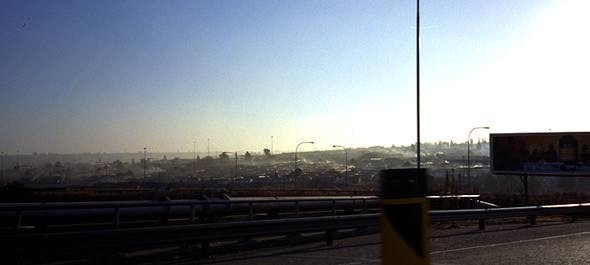 Yesterday was an interesting day. In order to get to Soweto, and hang with my friend Amelia's family, I had to rent a car. Easier said than done in S. Africa, where everybody drives on the lefthand side of the street and sits on the righthand side of the car.
 My girlfriend's cousin Ref accompanied me to AVIS Rent-a-Car, which had just rented out their last automatic before our arrival. Ref called around to some more dealers around town checking for automatics, but there weren't any available.
So I, being the fierce woman that I am, agreed to rent a standard and just figure it out. "After all, how hard could it be?" I added.
I must inspire a lot of confidence in people, because the dealer handed me a pair of keys to a cute little black VW golf. And after a cursory explanation of what the clutch, brake, and accelerator were, Ref left me in the parking lot as he dashed off to a meeting.
Several stalls, shakes, and screeches later, one of the AVIS guys explained how to ease back on the clutch while applying light pressure to the accelerator. Several more jolts and stops after that, another walked up and asked if I was studying for my driver's license. I assured him that I had in fact been driving for a decade, just never a manual. Then a guy from the pizza joint next door, Thomas, agreed to give me some lessons around the parking lot.
He was a lifesaver. Three hours and a couple of tests later (parking, accelerating, reversing), I was declared fit for the road.
I got out into traffic and my car stalled about a half block away from the parking lot. I couldn't get it started. As people started honking I hoped Thomas would come running to help, but he was nowhere to be found.
A few kind men watching from the side of the road pushed me off the street into a taxi depot and suggested I call my mother or boyfriend to come pick me up. As they walked off, a gaggle of local traders and beggars gathered to watch the spectacle, smirking as my car sputtered, stalled and stopped until I finally got it moving and on the road again. Thankfully, I barely stalled all the way back to my girlfriend's house.
Fast forward a day later when I declared myself fit to drive to Soweto.
Despite my ignorance of maps, I found some very kind people who directed me towards Soweto on the outskirts of Joburg. On my way to Zone 6 in Meadowlands, I took a wrong turn and ended up in an entirely different town. I stopped by a makeshift car garage where a bunch of twenty-something-year-old bright-eyed boys were cleaning and fixing up cars. After they explained how to get to Zone 6, I was more confused than before I stopped. Seeing the glazed look in my eyes, three of the guys offered to direct me there as though it were an ad hoc field trip. They hopped in and started giving directions.
The deeper you go downtown, the more crowded it gets. You immediately know you have left town because all the spaces disappear between the houses and each fence is ringed with barbed wire. There's also very little open space. Soweto is so crowded -- almost like a traffic jam. It reminded me of more of what I'm used to of my fam in NG as compared to staying in the suburbs of Joburg. The tin roofs, broken lightbulbs, and buckets for bathing -- but with the addition of TVs, ATMs, clubs, and internet cafes.
By the time we finally arrived at my friend Amelia's family's house, it was too late to see any of the sites, so we chilled a bit and tried to hit up a few clubs. There was The Ozone, The Rock, and White Horse, complete with neon flashing lights and red painted walls.
People in Soweto were living life, albeit crowded in to tiny spaces. I hope to make it back there someday, but maybe in an automatic.
I'm leaving town for my girlfriend's wedding in Botswana this weekend. We went to undergrad together at Stanford and have been each other's family in NYC for the past couple of years. She's from all over -- South Africa, Lesotho, Zimbabwe, and Botswana -- and is marrying a white boy from Oklahoma that's so down everyone assumes he's at least Puerto Rican. They met at church and it's been history ever since.
It's about time that I took a vacation. Every now and again I get that itching to flee the US as fast as possible. I've been to quite a few places -- Brazil, Belize, and S. Africa, among others. My first really major trip, outside of family trips back home to Nigeria, was the summer after my sophomore year of college that I spent in Accra.
I was there for 9 weeks, studying plant medicine at the University of Ghana-Legon. At the time, I was a fearless and naive 19. Not speaking a word of Twi, I rode a tro-tro every Tuesday and Thursday to class with folks from the Ghana Dance Ensemble and National Theatre; took a bus ride down to Cape Coast with some friends for Panafest; and a bus tour to Kumasi just to see the sights.
I have some video of myself dancing at a rehearsal, whirling round and round, my hair cut in a short afro. Man. I had so much gumption! Actually got into a taxi once and told the driver that I didn't know where I was going, but could he please help me find it. LOL.
I think it's only when we travel that we come to understand ourselves and our place in the world better. Here's to more travel and life lessons.
It's about time that I took a vacation. Every now and again I get that itching to flee the US as fast as possible. I've been to quite a few places -- Brazil, Belize, and S. Africa, among others. My first really major trip, outside of family trips back home to Nigeria, was the summer after my sophomore year of college that I spent in Accra.
I was there for 9 weeks, studying plant medicine at the University of Ghana-Legon. At the time, I was a fearless and naive 19. Not speaking a word of Twi, I rode a tro-tro every Tuesday and Thursday to class with folks from the Ghana Dance Ensemble and National Theatre; took a bus ride down to Cape Coast with some friends for Panafest; and a bus tour to Kumasi just to see the sights.
I have some video of myself dancing at a rehearsal, whirling round and round, my hair cut in a short afro. Man. I had so much gumption! Actually got into a taxi once and told the driver that I didn't know where I was going, but could he please help me find it. LOL.
I think it's only when we travel that we come to understand ourselves and our place in the world better. Here's to more travel and life lessons.

Ousmane Sembene died last Saturday, at the age of 84, after a long illness. Dubbed the Father of African cinema, he was a brilliant writer and hero of mine, and will be sorely missed.
Sembene said, in a recent Guardian interview, "I think big campaigns such as Make Poverty History and Live 8 are fake, and I think African heads of state who buy into that idea are liars. The only way for us to come out of poverty is to work hard."
Speak on it.

I stole a copy of the New York Times Magazine on the way out of my favorite cafe last week. I opened it up on the F-train heading downtown and found an excerpt from an upcoming memoir by Ishmael Beah, A Long Way Gone. In it, Beah details his conscription into the army after his family was killed in the Sierra Leonean Civil War; his rescue and rehabilitation by UNICEF; and relocation to New York City, where he was adopted by a Jewish woman.
By the time I reached my subway stop in Brooklyn, I was weeping.
I don't understand war and I don't understand involving and subjecting children to it. It's telling that in order to further the committal of incomprehensible acts -- that of maiming and killing innocents -- one need necessarily employ children, who lack the judgment of reason and wisdom of mercy.
Ishmael's story was strikingly similar to that of Adu, the protagonist in Uzodinma Iweala's Beasts of No Nation, chronicling the life of a young boy from an unnamed African village who is conscripted into service as a child soldier.
I've been working on it for awhile now, though it's a quick and tantalizing read at 143 pages. The only thing standing in the way of finishing it is my own ego.
I have this terrible habit of comparing myself to other writers. Iweala is my contemporary, graduating from Harvard with a B.A. in English, and came out with this debut novel in 2005. He reminds me that I could be doing so much more with my life.
The first twenty pages of this novel blew me away. He writes in a dialect similar to pidgin English, but unique in its own way. That and the entire novel written in stream of consciousness made it a book of note -- and of the year by Time, People, Slate, Entertainment Weekly, and New York Magazine.
What I find more remarkable, even more than Beah and Iweala's command of their craft, is that their stories are being told at all.
When I look at my father writing his memoir and Ishmael sharing his story bravely, I realize the revolutionary power of words, especially for those of us that have been systematically silenced -- whether by power, culture, or faith -- namely, African women. Even as I sit here writing this blog, I am exercising my belief in the word.
It is its own reward.

I went to BAM for the New York premiere of Twelve Disciples of Nelson Mandela, by Thomas Allen Harris. If it's in your town, go see this film. It chronicles the lives of twelve boys who paved the way for the anti-apartheid movement in exile, told from a stepson's perspective. Harris uses the film to come to terms with the relationship he had with his stepfather, the late B. Pule Leinaeng (Lee), a pivotal force among the twelve.
It was really powerful. Not only because it told a story that might have gone unspoken, but also becauseit put names and faces to some of the countless freedom fighters that are so often overshadowed by the greats. These young boys burned their passbooks and left South Africa with a dim vision of freedom, and no real idea of what challenges they would encounter. Not all of them made it back either, and for those that did, over 30 years had passed before their victorious return.
Many exiles to the U.S. were shocked by the lack of media attention paid to the anti-apartheid movement. Lee, the main subject of the film, studied journalism and television production. He made it his mission to record every photograph of the movement he came across, and started several unfinished films, but had difficulty making it in the business as a foreigner, though he ultimately landed a job at a UN-run anti-apartheid radio show.
Hearing that gave me a lot of gusto. For the first time ever, I was positive I made the right decision to pursue film.
Nobody ever encouraged me to do anything but science. I used to say, in my journal, that my dream was to be a writer. And I never ever told anyone that, scared it was too "soft" or frivolous. Even at my mother's death bed, my uncle took me aside to chide me for deciding against medical school.
After several fits and starts -- into PR, communications, and fashion among other things -- I came full circle back to this writing thing, and started saying it out loud, hanging out with other writers. Then realized I could challenge myself even more, so I took a shot at film school.
There are two things I know for sure. One, that people complain a lot about things that they have no intention of fixing. Like, for instance, the dearth of positive images of blacks, women, and Africa on the silver screen. I'm putting my money where my mouth is rather than run the risk of becoming such a person.
Secondly, we're all capable of way more than we think we are. Universally. The main thing holding us back from realizing our full potential is ourselves. I talked myself out of applying the year before last, and almost did it again, thinking I wasn't marketable enough yet. I didn't realize that passion was enough, even without a lengthy CV to back it up. Good thing God had bigger plans for me.
If a man who watched his people get beaten, shot, tortured, and dehumanized grabbed a pen and a camera, I must be on to something.

